
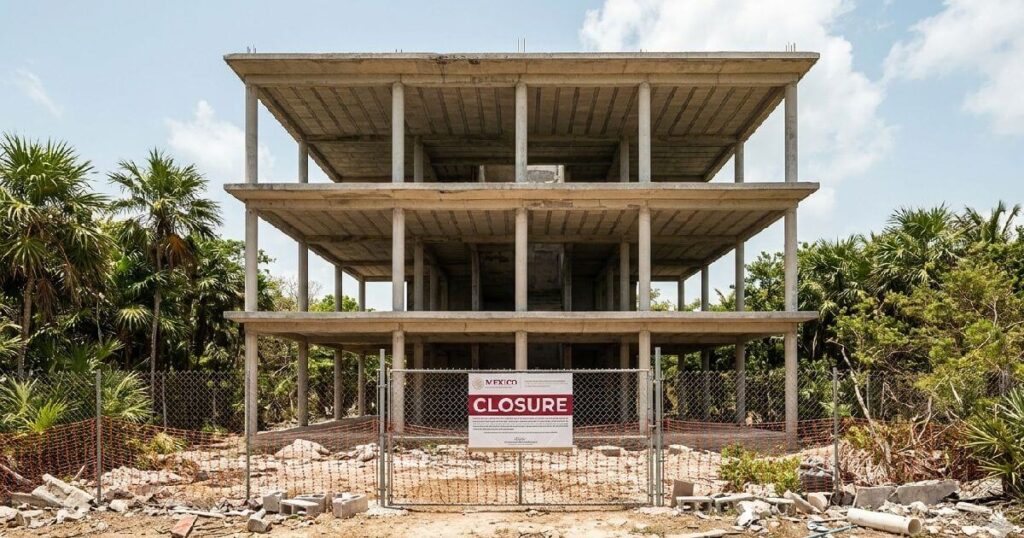
Tulum real estate shutdown activity has accelerated significantly — and most buyers never see it coming.
Authorities in Quintana Roo have shut down 18 real estate developments in the past six months for regulatory violations. The state’s own regulatory agency has flagged another 116 properties statewide. Furthermore, in nearly every case, developers were still actively marketing these projects to buyers — on social media, on real estate platforms, and through agents — while the government was in the process of shutting them down.
This is not an isolated incident. However, it is a documented pattern that every prospective buyer in this market needs to understand before committing any money.
What the Tulum Real Estate Shutdown Data Shows
According to a February 2026 report published by PorEsto, one of Quintana Roo’s leading news outlets, the state’s Secretariat of Territorial and Urban Development — known as Sedetus — conducted more than 125 inspection visits in Tulum and Playa del Carmen over a six-month period. Consequently, the violations found include construction without permits, development on environmentally protected land, projects built without federal environmental impact authorization, and sales of properties without legal land use approval. Sedetus maintains a public registry of flagged developments. As of this writing, 116 properties appear on that list.
Officials made one point with particular clarity: verifying permits before purchase is the buyer’s responsibility. Not the developer’s. Not the agent’s. The buyer’s.
In Mexico, that has always been true.
What Buyers Are Typically Told
Most international buyers purchasing in the Riviera Maya corridor receive similar assurances. The developer has all the permits. The notary reviewed everything. The agent has worked with this developer before. Additionally, the developer has been selling the project for two years and has nearly exhausted inventory.
However, none of those statements independently verify anything. A notary in Mexico authenticates signatures — they do not confirm that a development has environmental authorization, municipal permits, or a legal land use classification. An agent’s prior relationship with a developer does not verify legal standing. Furthermore, nearly selling out a project reflects effective marketing and nothing more.
The developments shut down in Tulum were not obscure projects. Developers actively promoted several of them on digital platforms right up to the moment of closure. As a result, buyers who had already paid deposits had no way of knowing the legal status of their investment.
What the Public Registry Does and Does Not Do
Sedetus maintains the Registro Estatal de Desarrollos Irregulares — the State Registry of Irregular Developments. Anyone can use this public-facing platform to look up whether authorities have flagged a specific project. It is a useful tool and genuinely worth consulting before any purchase.
However, it is not a guarantee of a clean status.
Authorities can add a project to the registry tomorrow even if it does not appear there today. Moreover, a development can sit in the middle of a regulatory review — with inspections completed and closure proceedings underway — and still not appear as flagged in real time. The registry captures only enforcement actions that authorities have already completed or formally initiated. It does not reflect what inspectors found last week or what complaints are currently under evaluation.
Consequently, consulting the registry is a reasonable starting point for any buyer doing their own research. It is one layer of a process that requires several.
How Buyers Can Protect Themselves Before Any Commitment
Before any purchase commitment — before a deposit, before a letter of intent, before a promissory contract — buyers should independently confirm the legal standing of that specific project. That means verifying the following:
- Municipal construction permits — confirm the developer holds current, valid permits covering the full scope of construction
- Environmental impact authorization from Semarnat — required for any development near protected land or coastal zones
- Legal land use classification — confirm the permitted use matches exactly what the developer is selling
- Title history — is the land free of ejido claims, liens, or unresolved legal challenges
Buyers can access all of this information without special permission. It exists in public records and government registries. Additionally, none of it requires special access or legal expertise to request. It requires knowing exactly where to look, understanding what each document means, and recognizing when something critical is absent. Buyers who take these steps before signing are in a fundamentally stronger position than those who rely on what the developer presents.
The Bottom Line on Tulum Real Estate Shutdown Risk
Eighteen developments shut down. Authorities flagged 116 statewide. Developers continued marketing projects while regulatory action was already underway. State officials are placing the responsibility for permit verification squarely on the buyer.
The Riviera Maya remains one of the most actively purchased real estate markets in Latin America. The demand is real, and the opportunities are genuine. However, the legal framework that protects buyers in the United States or Canada does not exist here in the same form. Therefore, the responsibility for knowing what you are buying falls entirely on the person writing the check.
Buyers who understand that reality going in — and who verify independently before signing — are in a fundamentally different position than those who find out after the fact.
Source: PorEsto, Quintana Roo — February 14, 2026. Original reporting in Spanish.