
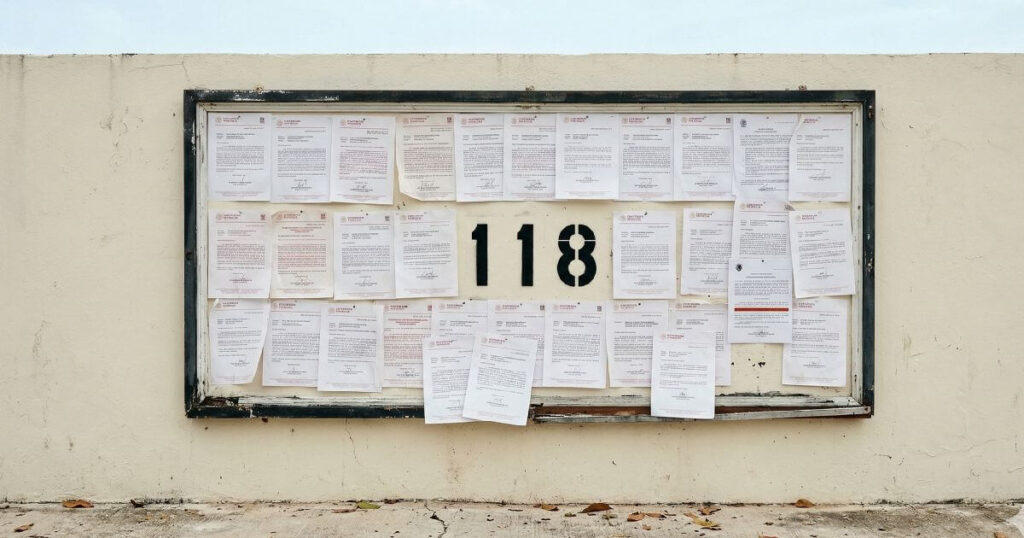
Quintana Roo irregular developments now number 118 — and the list grew just this week.
On March 7, 2026, Quintana Roo’s Secretariat of Territorial and Urban Development — Sedetus — added two more projects to its official registry of irregular developments. The newly flagged projects are Aurea in Tulum and San Valentín on the continental zone of Isla Mujeres. Authorities flagged both while buyers were still actively purchasing them. Neither held the required urban congruence permit from the state. Neither carried the corresponding municipal construction licenses. Both violate Quintana Roo’s Law on Human Settlements, Territorial Planning, and Urban Development.
Both were still advertising on digital platforms when authorities stepped in.
This is not a story about two bad projects. Buyers are making purchase commitments in a market where the legal landscape is largely invisible to them. That is the real story.
What the Sedetus Registry Is
Sedetus maintains the Registro Estatal de Desarrollos Irregulares — the State Registry of Irregular Developments. Any buyer can search this publicly accessible database to check whether authorities have formally flagged a specific project. Sedetus updates the registry as new enforcement actions reach completion.
The registry currently lists 118 entries across multiple municipalities, including Tulum, Isla Mujeres, Benito Juárez, Othón P. Blanco, Bacalar, Puerto Morelos, Mahahual, Playa del Carmen, and Cozumel. Violations that land a development on this list include selling without state urban-congruence permits, building without municipal licenses, developing on environmentally protected land, and constructing without a federal environmental impact authorization from SEMARNAT.
How to Search the Registry
Every buyer researching a property in Quintana Roo should consult this free public resource before making any payment. To search the registry, directly visit:
Type the name of the development you are researching. Results show the nature of the irregularity, the current enforcement status, the municipality, and the specific action Sedetus is taking on that project.
What the Registry Does Not Show
The registry is a valuable tool. It does not tell the complete story of risk in this market.
Authorities only add developments after completing the formal inspection and enforcement process. Projects currently under investigation do not appear. Developments where complaints exist but verification remains incomplete do not appear. Projects operating without permits that nobody has yet reported or inspected do not appear either.
Sedetus has acknowledged publicly that citizen complaints directly drive new registry entries. Each new complaint triggers a new inspection, which may produce a new entry. The 118 currently listed represent developments authorities have already documented and processed. The true number of irregular projects operating across the state at any given moment remains unknown — and almost certainly exceeds what the registry shows.
Authorities have also stated publicly that the pattern in many of these cases — collecting payments, failing to deliver, and in some instances vanishing entirely — meets the legal definition of fraud under Mexican law. Several criminal complaints are already on file.
Why Quintana Roo Irregular Real Estate Developments Keep Increasing
The pattern behind Quintana Roo’s irregular development shows no signs of slowing. In September 2025, authorities publicly named 26 Tulum developments actively selling properties without legal permits — a separate enforcement action that shows how broadly this problem runs across the state.
The underlying conditions driving this pattern show no signs of changing. Quintana Roo ranks among the fastest-growing real estate markets in Latin America. The Maya Train, airport expansions, and new highway corridors are simultaneously pushing demand and land values higher. Developers of every size and financial standing are entering the market faster than regulators can review them.
Completing the permit process in Mexico requires navigating municipal, state, and, in many cases, federal approval through Semarnat for environmental clearance. Developers who begin marketing and selling before finishing that process — a common practice — expose buyers to legal risk that remains completely invisible at the point of sale. The property looks real. The contract looks real. The marketing looks professional. The legal foundation may not exist at all.
What Buyers Should Verify Before Signing Anything
Checking the Sedetus registry is the starting point. Independent verification should go further. Before any purchase commitment — deposit, letter of intent, or promissory contract — buyers should confirm the following:
- The development does not appear on the Sedetus irregular developments registry
- Municipal construction permits exist and are current for the specific scope of what is being built
- Semarnat has issued an environmental impact authorization, which the project requires it
- A title search at the Registro Público de la Propiedad confirms the land is free of liens, mortgages, and ejido claims
- The developer is a legally constituted company with verifiable financial standing — not a shell entity or an undercapitalized sole proprietorship
All of this information exists in public records and government registries. Accessing it requires no special permission. It requires knowing exactly where to look, understanding what each document means, and recognizing when something critical is absent.
The Bottom Line in Quintana Roo irregular developments
One hundred and eighteen developments flagged. The list grew by two in a single week. State authorities are publicly using the word fraud. Buyers are still signing contracts on projects that appear nowhere in any public registry — because the registry only captures what inspectors have already found.
The government created this registry because buyers needed a tool to protect themselves. That step matters. A tool only works, however, when the person at risk knows it exists, understands how to use it, and recognizes what it cannot tell them.
In this market, that knowledge is the difference between a sound investment and a very expensive lesson. In Cancún, the same pattern led to arrests — two men now face 22 open fraud files after signing buyers at notary offices for properties they never owned.
Source: PorEsto, Quintana Roo — March 7, 2026. Original reporting in Spanish.